



WINTHROP & CO. EXCLUSIVE PROFILE
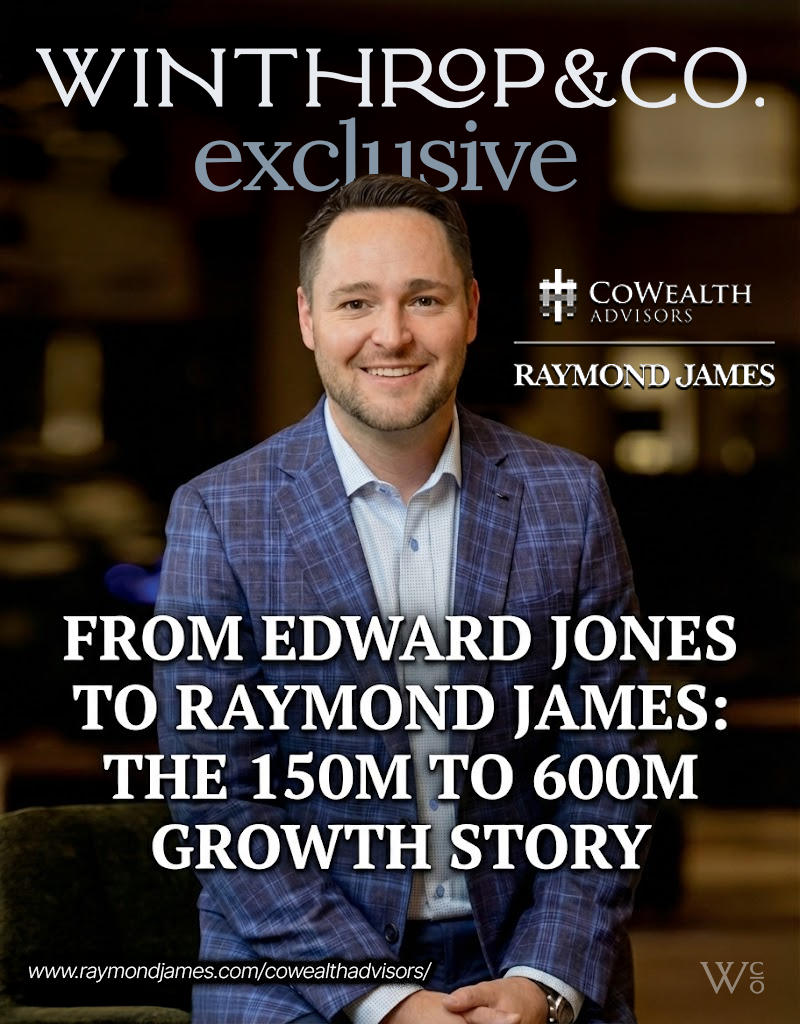
From Edward Jones to Raymond James: The 150M to 600M Growth Story
Inside the build: team, standards, client experience, and what shifted after the move that allowed CoWealth Advisors to scale.

WINTHROP & CO. EXCLUSIVE PROFILE
From $150M to $600M
How Josh Colwell Built CoWealth Advisors
Early in his career, Josh Colwell did what high-performing advisors do: he built trust, accumulated momentum, and developed a substantial practice. The more consequential chapter came later, when he chose to design a business with durable standards, deliberate structure, and a client experience capable of scaling without dilution. That decision became the foundation for CoWealth Advisors.
The Starting Point: A Builder, Not Simply a Producer
Josh Colwell began his career as a financial advisor in 2013, spending nearly a decade developing his craft within the Edward Jones system. By 2021, he had built a sizable practice and was already thinking beyond near-term production. His focus was on outcomes, continuity, and the ability to expand capacity without compromising service.
Elite advisors do not plateau because they lose intensity. They plateau when a captive operating model imposes a structural ceiling: uniformity, slower decision-making, and limited control over the client experience. For Colwell, the gap between the level of advice he wanted to deliver and the standardized framework surrounding him became increasingly difficult to ignore. At that point, the strategic question becomes straightforward: continue optimizing inside someone else’s structure, or build the structure himself.
There’s a meaningful distinction between growing a book and building a firm. Josh Colwell built a firm.
The CoWealth Standard: Planning as the Operating System
CoWealth does not treat planning as an accessory. It is the firm’s operating system. The work begins with a structured process built around client goals and real-world constraints. This orientation matters because it prevents implementation from becoming a collection of tactics. Instead, it becomes a calibrated sequence: clarify objectives, define tradeoffs, evaluate feasibility, and construct a plan engineered to hold up under pressure.
This approach also creates consistency. When planning is the core discipline, the client experience becomes repeatable across relationships and across the firm, rather than dependent on the instincts of a single advisor.
Relationship First, Then the Numbers
Colwell and his team lead with relationship and context before the technical work begins. That sequencing is intentional. It allows the plan to reflect the client’s priorities, fears, and expectations in a way that increases both clarity and follow-through.
The firm also made an explicit decision to prioritize “quality versus quantity.” By limiting relationships and rejecting a volume-driven model, they create the capacity for deeper discovery, more precise planning, and a client experience defined by genuine familiarity. That depth becomes a competitive advantage over time. Clients act faster, share more information, and remain more committed to the plan because the relationship is not transactional.
Risk Discipline That Protects the Plan
The firm’s discipline around risk management is central to the client experience. Rather than treating risk as an abstract concept, they operationalize it through scenario work and stress testing. Portfolios are evaluated in the context of the plan, measuring how different outcomes affect the probability of success, then adjusting risk to align with what the goal actually requires.
This is not merely investment management. It is behavioral protection. The plan is designed to anticipate adverse periods so clients do not abandon the strategy when volatility arrives. In practice, this reduces emotional decision-making and preserves long-term continuity.
The Move and the Build: Enterprise Over Personality
Independence was the enabling step, not the outcome. The outcome was the ability to build a firm on purpose, process, and people. The transition gave Colwell the freedom to implement a higher standard of care and a more intentional operating design. CoWealth is structured as an enterprise rather than a founder-centered practice.
Distinct roles, dedicated investment oversight, multiple advisors, and client service depth create capacity and consistency. The client relationship resides inside the firm, not inside one person’s calendar. Service does not pause when the founder is occupied, traveling, or focused on growth.
"The saying: 'it takes a village' doesn't just apply to raising a family, it equally applies to building an organization. Surrounding myself with high character, like minded people, is the secret ingredient of turning a practice into an organization and creating something that positively impacts as many people as possible."
— Josh Colwell, CFP®, CEPA®, AAMS®
Founder, CoWealth Advisors I Financial Advisor, RJFS
Honesty as a Differentiator
Colwell’s model requires directness. When goals are not currently supported by the numbers, the firm addresses the gap transparently. They show the analysis, clarify what would need to change, and then build strategy around the objective once the client confirms the priority. That is a hallmark of ownership. It replaces reassurance with clarity, and it strengthens trust because clients know the plan is grounded in reality.
Why the Growth Compounded
Scaling from roughly $150M to approximately $600M is the result of intentional business design. Planning remains the centerpiece. Risk is managed through a repeatable process. The firm is built to increase capacity without lowering standards. Branding also matters. The name “CoWealth” signals partnership and shared pursuit, positioning the firm as an institution rather than a personality. Over time, that supports continuity, referrals, and a client experience designed to outlast any single individual.
In closing, transitions are demanding. The early months require extraordinary focus and operational lift. But Josh Colwell’s story is not simply a change of firm. It is a case study in designing a business with standards: planning-led, relationship-first, and built for continuity.
That is how a strong practice becomes a durable enterprise.
Josh on Winthrop & Co.
"Partnering with Rob taught me more about the independent space than I would have learned in several years on my own. I'm grateful to him and his team and would recommend them to anyone exploring their options in the financial industry."
Proven results. Real transitions
Key questions to pressure test
01. What do client contact and communication rules look like before and after a move?
02. How will technology, data access, and pricing evolve for your book?
03. What transition support and resourcing are guaranteed in writing?
04. How do current economics compare to equity and ownership alternatives?
05. What are realistic timing and portability scenarios for your households?
Get your options memo
Compare your paths
Stay put, but tighten the model. Pressure test payout, staffing capacity, and service standards. Build a 12–18 month plan that improves the business whether you move or not.
Independence without being on an island. Plug into existing offices or build your own, while keeping the full resources and support you’re used to for scaling, service, and growth.
Multi-custody access, flexible pricing, and potential equity participation. Good fit when you want independence with shared services and supervision.
Full ownership of brand, data, and client experience. Control the stack and pricing. Build a chassis that supports tuck-ins and M&A.
Evaluate retire-in-place programs against open-market sunset options. Compare multiples, control, and client continuity on facts.
Your move. Our expertise.

What you get when we work together
- Options memo with three to five credible fits tailored to an Edward Jones practice.
- Term-sheet matrix comparing economics, equity, capital, tech, data, and support.
- Diligence plan with leadership meetings and service validation.
- Legal coordination with independent counsel on timing and portability.
- Transition timeline and day-one readiness plan.
- Client communications kit that keeps outreach clean and confident.
Proven results. Real transitions
Edward Jones–specific diligence prompts
- Client ownership, acceptable pre-move activities, and compliant communication.
- Ability to add advisors or licensed staff and design a real successor path.
- Access to alternatives, private investments, and institutional features.
- Data export, integrations, and reporting for complex households.
- Written commitments for recruiting support, transition teams, and service SLAs.
Get Your Options Memo
★★★★★ Exclusive insights for top advisors

Tools & resources
- Due Diligence Question Bank
- Options Memo sample
- Day-One Readiness checklist
- Confidential Call script for top households
Mini outcomes
- Senior producer moved to a platform with full discretion and modern tools, stabilized pricing, and improved reporting in the first quarter.
- Team compared Boutique and Hybrid options, chose equity participation with defined governance, and preserved client experience.
- Solo advisor launched an RIA, simplified the stack, and increased net take-home while improving client communication (Details anonymized for confidentiality.)
Frequently Asked Questions
We guide financial advisors through confidential due diligence and transition planning, with staged outreach and controlled evaluation.
Your move. Our expertise.
Is this confidential?
Yes. Outreach is controlled and meetings are staged. Documents follow clean protocols aligned to your portability plan.
Do I pay for this?
No. Our contracts sit with firms and solution providers. We serve as your unbiased counterpart.
How long does a process take?
Typical timelines run 60 to 120 days from first diligence call to day one. We move at your pace.
Will my clients follow?
When the new platform clearly improves their experience, portability is strong. We design communications and timing to support that outcome.
Do you only work with a few destinations?
No. We maintain access across wirehouse, boutique, hybrid-RIA, and RIA options so comparisons are based on facts, not headlines.
Where do we start
Ask for your Edward Jones Options Memo. We will map objectives, build the shortlist, and show you a clear path from diligence to day one.
★★★★★ Get your options memo