
Free guide: Merrill Lynch edition
The Merrill Movement Report: H1 2026
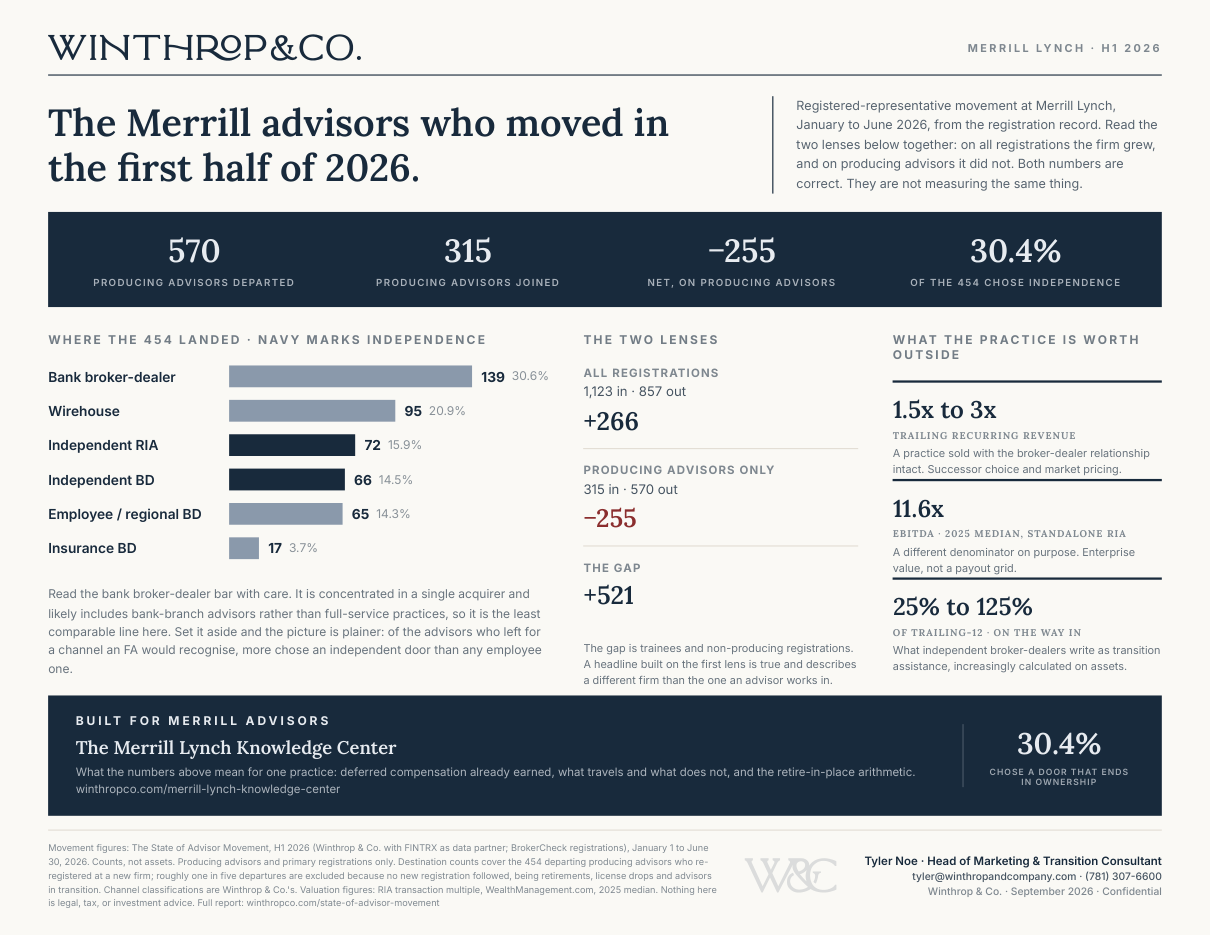
570 producing advisors left and 315 joined, a net loss of 255, while the all-registrations count grew. Both lenses, where the leavers landed, and what a practice is worth outside.
What's inside
A single-page brief built for Merrill Lynch advisors from The State of Advisor Movement's registered-rep data. Two counts of the same firm read side by side, because they disagree and both are correct: on all registrations Merrill grew, and on producing advisors it did not. The destination table for all 454 departing producing advisors who re-registered, and the three ways a practice is priced outside the firm.
- Both lenses: 1,123 in and 857 out on all registrations, 315 in and 570 out on producing advisors
- Where the 454 re-registered leavers landed, across six destination channels
- 30.4% chose a door that ends in ownership, and why the bank channel line needs care
- What the same practice is worth outside: revenue multiples, EBITDA multiples, transition assistance
Delivered privately to your inbox. No newsletter, no follow-up unless you ask.
Two counts of the same firm, and both are correct
Registered-rep movement data from The State of Advisor Movement, H1 2026 shows 1,123 registrations arriving at Merrill Lynch and 857 leaving, a net gain of 266. On producing advisors only, the same window shows 315 in and 570 out, a net loss of 255. The gap of 521 is trainees and non-producing registrations. Neither number is wrong. A headline built on the first describes a different firm than the one an advisor works in, which is why the brief prints both on the same page.
Where the 454 went, and the one line to read carefully
Of the 570 producing departures, 454 re-registered at a new firm by the end of June. A bank broker-dealer took 139 of them, 30.6%; a wirehouse 95, 20.9%; an independent RIA 72, 15.9%; an independent broker-dealer 66, 14.5%; an employee or regional broker-dealer 65, 14.3%; and an insurance broker-dealer 17, 3.7%. The bank line needs care: it is concentrated in a single acquirer and likely includes bank-branch advisors rather than full-service practices, so it is the least comparable figure on the page. Set it aside and the picture is plainer. Of the advisors who left for a channel a Merrill advisor would recognise, more chose an independent door than an employee one. Counting the independent RIA and independent broker-dealer channels together, 30.4% chose a door that ends in ownership.
Common questions
How many advisors left Merrill Lynch in the first half of 2026?+
570 producing advisors departed Merrill Lynch between January and June 2026 while 315 joined, a net loss of 255, per registered-rep movement data prepared for The State of Advisor Movement. Counted on all registrations rather than producing advisors, the same window shows 1,123 in and 857 out, a net gain of 266. The difference is trainees and non-producing registrations, and the two numbers describe the firm very differently.Where do Merrill Lynch advisors go when they leave?+
Of the 454 producing advisors who left and re-registered in H1 2026, a bank broker-dealer took 30.6%, a wirehouse 20.9%, an independent RIA 15.9%, an independent broker-dealer 14.5%, an employee or regional broker-dealer 14.3%, and an insurance broker-dealer 3.7%. The bank figure is concentrated in a single acquirer and likely includes bank-branch advisors rather than full-service practices. Counting the two independent channels together, 30.4% chose a destination that ends in practice ownership.What is a Merrill practice worth outside the firm?+
Three different prices, on three different denominators. A practice sold with the broker-dealer relationship intact has commonly traded at roughly 1.5x to 3x trailing recurring revenue, with successor choice and capital-gains treatment. A standalone RIA is valued on earnings instead, and the median RIA transaction closed at a record 11.6x EBITDA in 2025. On the way in, independent broker-dealers write transition assistance of roughly 25% to 125% of trailing-twelve production, increasingly calculated on assets rather than revenue.Does Merrill's CTP count as selling my practice?+
No. A retire-in-place program pays a defined share of production over a transition period with the successor chosen by the firm and a non-compete attached, and the book stays inside the firm. At the top production tiers these programs are genuinely competitive. What they are not is a sale, which is why the brief prices them against an open market where a practice trades on a multiple with successor choice. The deferred compensation already earned, and what travels with you and what does not, are covered in the Merrill Lynch Knowledge Center.
Flagship research
The full picture lives in The State of Advisor Movement.
Six months of measured advisor movement: the firm-by-firm ledger, destination channels, deal economics, and the rent-or-own framework, in an interactive edition and a 41-page print edition. Both free.