
Free guide: Edward Jones edition
The Edward Jones Movement Report: H1 2026
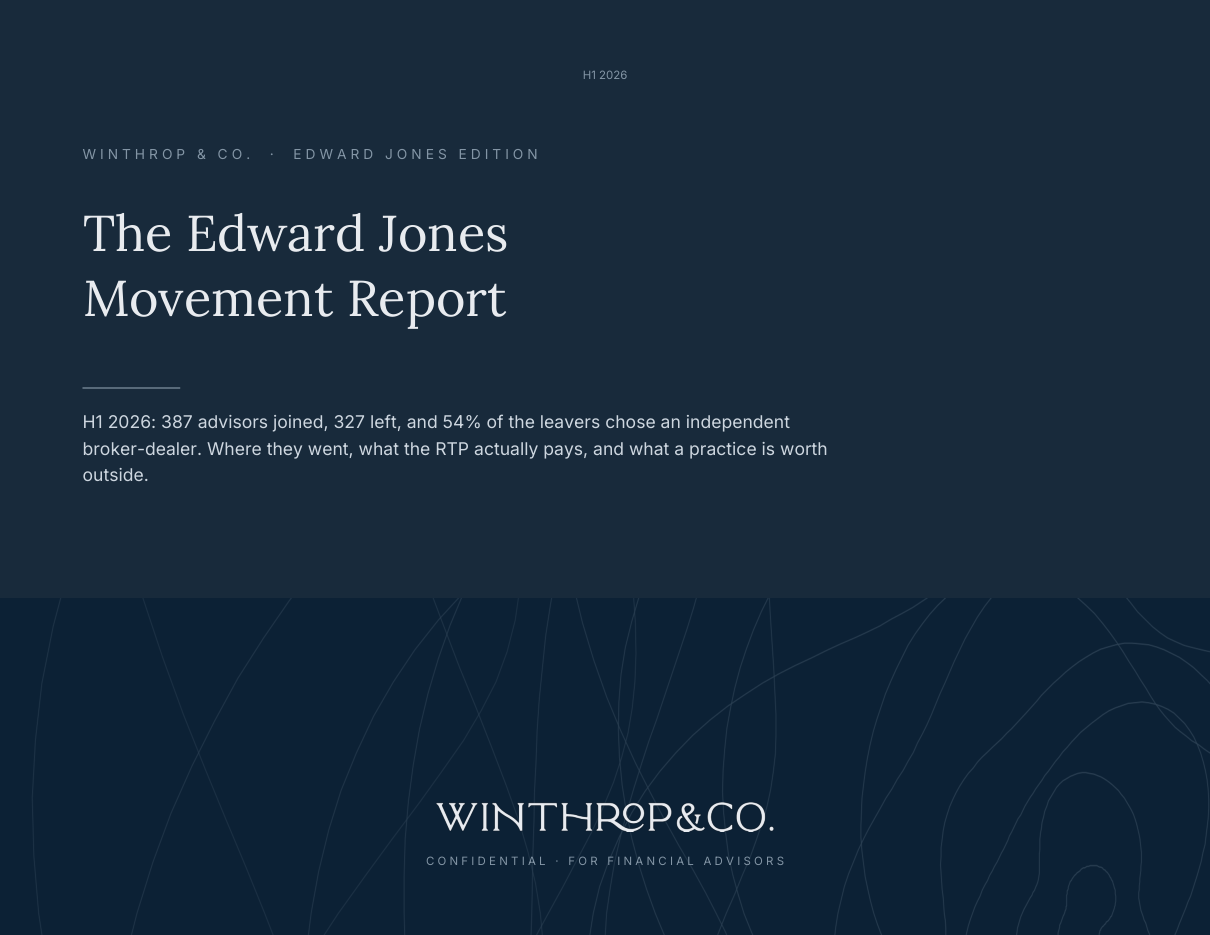
387 joined, 327 left, and 54% of those who re-registered chose an independent broker-dealer. Where they went, what the RTP pays, and what a practice is worth outside.
What's inside
A six-page brief built for Edward Jones advisors from The State of Advisor Movement's registered-rep data and the firm's own published documents. The H1 2026 ledger for Edward Jones specifically, the destination table for all 265 leavers who re-registered, the Retirement Transition Plan priced from the firm's SEC filing and Financial Opportunity Guide, and the arithmetic for what the same practice is worth on the open market.
- Edward Jones' H1 2026 ledger: 387 joins, 327 departures, 28 direct breakaways
- Where the 265 re-registered leavers landed, by destination channel
- The RTP decoded: the five-year shape, the published 170-300%+ band, depending on the book, and the fine print
- What the same practice trades for outside: revenue multiples, EBITDA multiples, IBD packages
We'll email it to you as soon as you submit (in Gmail, check the Promotions tab).
Where Edward Jones advisors actually went in 2026
Registered-rep movement data from The State of Advisor Movement, H1 2026 shows 387 producing advisors joined Edward Jones and 327 departed in the first half, a net gain of 60. Of the 265 leavers who re-registered by the end of June, 54% chose an independent broker-dealer, led by LPL, Raymond James Financial Services, and Ameriprise, and 15.5% went to an independent RIA. Put together, roughly 7 in 10 of them chose an independent channel, while only 7.5% went to a wirehouse. The single-FA branch model turns out to be strong preparation for running an independent practice.
The Retirement Transition Plan, priced from the documents
The RTP is the Edward Jones model's only monetization path, and its real terms live in the firm's SEC filing and published Financial Opportunity Guide: a five-year agreement combining two further years as a W-2 employee, retirement, and a three-year non-compete, with payments spread over roughly four years. The published band runs 170% to 300%+ of revenue from relationships transitioned for $1M+ producers, depending on the book, with a 50% to 120% base below that. It is competitive with other firms' sunset programs at the top. The book stays inside the firm, limited partnership capital returns at book value, and the advisor holds no sellable interest at term. The brief prices it against the open market, where practices trade at roughly 1.5x to 3x recurring revenue under a broker-dealer and RIA firms traded at a record median 11.6x EBITDA in 2025.
Common questions
Where do Edward Jones advisors go when they leave?+
Measured from registered-rep data covering the 265 producing advisors who left Edward Jones and re-registered in H1 2026: 54% joined an independent broker-dealer, led by LPL, Raymond James Financial Services, and Ameriprise; 15.5% went to an independent RIA; 9.8% to another employee or regional broker-dealer; 8.7% to a bank broker-dealer; 7.5% to a wirehouse; and 4.5% to an insurance broker-dealer. Roughly 7 in 10 chose an independent channel in some form.How many advisors left Edward Jones in 2026?+
In the first half of 2026, 327 producing advisors departed Edward Jones while 387 joined, a net gain of 60, per registered-rep movement data prepared for The State of Advisor Movement. 28 of the departures were direct breakaways to an independent RIA. The firm's own filings separately show the accrual for future Retirement Transition Plan payments rising from $150M to $228M in one year.What does the Edward Jones Retirement Transition Plan pay?+
Per Edward Jones' published Financial Opportunity Guide, advisors meeting the age and service requirements with $1M+ in gross revenue receive 170% to 300%+ of revenue from relationships transitioned, depending on the book; below $1M the base runs 50% to 120%. Per the firm's SEC filing, the agreement generally runs five years: two further years as a W-2 employee providing transition services, retirement at the end of year two, a three-year non-compete, and payments spread over roughly four years.Do Edward Jones advisors own their book of business?+
No. The branch practice and client relationships belong to the firm, limited partnership capital returns at book value rather than at a market multiple, and the RTP is the model's only monetization path. That is the core of the rent-or-own arithmetic: an outright sale on the open market carries successor choice, capital-gains treatment, and market pricing, at roughly 1.5x to 3x recurring revenue for practices under a broker-dealer umbrella, while RIA firms traded at a record median 11.6x EBITDA in 2025.
Flagship research
The full picture lives in The State of Advisor Movement.
Six months of measured advisor movement: the firm-by-firm ledger, destination channels, deal economics, and the rent-or-own framework, in an interactive edition and a 41-page print edition. Both free.